
Ejari Contract Addendum: 7 Proven Tips for Safe Terms
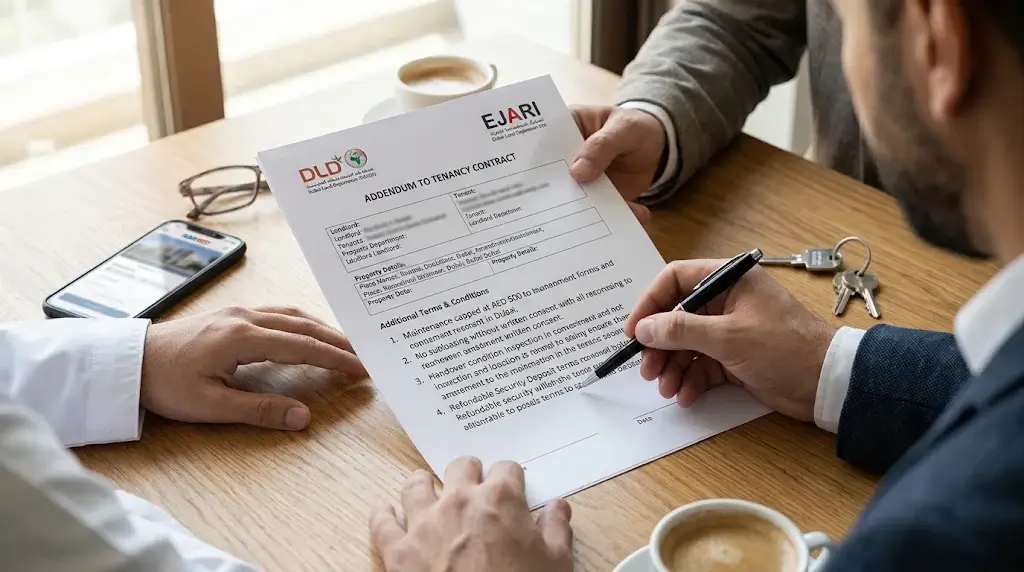
The standard Ejari tenancy contract covers the basics, such as names, rent, dates, and the property. But real life is rarely that simple. A tenant may want to keep a pet, or a landlord may want to set a limit on repair costs. This is where an Ejari contract addendum becomes useful. It lets both sides record extra terms in a clear and organised way.
This guide explains how to write additional clauses that Ejari contract parties often need, who must sign them, and what is not allowed. The information is general, so please confirm your own case with official channels before you sign.
What Is an Addendum and How Does It Work?
An addendum is a separate document attached to the unified tenancy contract. It holds extra terms that the landlord and tenant both agree on. The unified contract is the standard form issued by the Dubai Land Department (DLD), and the form itself notes that an addendum can be added when there are additional terms.
Many people call these Ejari special conditions. They sit on top of the standard form and help fill the gaps that the form leaves open.
A good Ejari contract addendum does three things:
- It records what both sides agreed in writing
- It reduces misunderstandings later
- It gives you something clear to show if a dispute starts
When Do You Need an Addendum?
You need one whenever your agreement goes beyond the standard terms. If everything is simple, the unified contract alone may be enough. But most real rentals have at least one special request.
Common reasons to add additional clauses that Ejari contract forms do not cover include:
- Pet permission or pet limits
- Maintenance duties and repair cost limits
- An early exit or break option
- Rules about renewal and rent payment dates
- Who pays for services such as chilled water or parking
- Special rules for commercial fit-outs
A tenancy agreement addendum Dubai landlords and tenants prepare is also common for commercial leases, where the number of extra terms is usually higher. In every case, the Ejari contract addendum should be agreed before the first signing, not after problems appear.
Do Both Landlord and Tenant Need to Sign?
Yes. The note on the unified contract says an addendum must be signed by all parties. Without both signatures, the extra terms may be hard to prove or enforce.
A signed rental contract addendum is much stronger than a verbal promise or a chat message. To keep it safe:
- Both the landlord and the tenant should sign every page
- Write the date next to each signature
- Each side should keep a full copy
- Attach it to the unified contract when registering, so the Ejari contract addendum is part of the same file
If a representative signs for the landlord, ask for proof of authority.
Can Special Conditions Override Dubai Tenancy Law?
No. Extra terms are valid only when they do not conflict with Dubai tenancy law. Any condition that goes against the law will not be considered, even if both parties signed it.
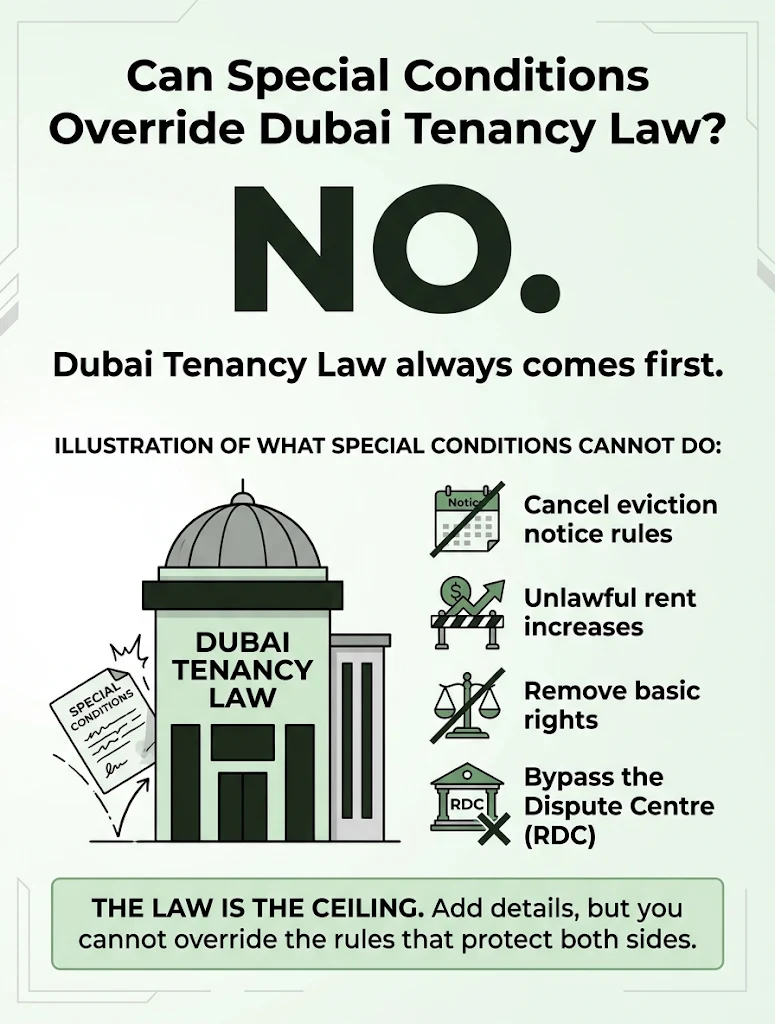
This means Ejari special conditions cannot:
- Cancel the legal notice rules for eviction
- Allow rent increases outside the legal framework
- Remove basic rights that the law gives to the tenant or the landlord
- Replace the legal dispute route through the Rental Dispute Centre
So when you write an Ejari contract addendum, treat the law as the ceiling. You can add details and fine-tune duties, but you cannot override the rules that protect both sides.
What Should Be Included in a Tenancy Contract Addendum?
Keep the document short, clear, and specific. Vague wording is the biggest cause of arguments.
Include these points:
- Full names of the landlord and tenant
- Property details and the contract number or reference
- The date of the addendum
- A numbered list of each extra clause
- Who pays for what, such as services, repairs, and fees
- Notice periods for ending or renewing the lease
- Any penalties, with clear amounts
- Signatures and dates from both sides
Some sources say additional terms may need to be provided in both Arabic and English, so ask about this before you finalise the tenancy agreement addendum that Dubai authorities will see. Also, number each clause so it is easy to refer to later. The Ejari contract addendum works best when each term can be read on its own.
Examples of Useful Special Conditions
Here are simple examples that many parties add:
- The tenant may keep one small pet, with damage repaired by the tenant
- The tenant pays for minor repairs below an agreed amount, and the landlord pays above it
- Either side may end the lease early with a set notice period
- The landlord will repaint the unit before handover
- Parking and storage rights are included for a stated number of spaces
Always write the exact amount or number. Words like reasonable or small can mean different things to different people.
Common Mistakes to Avoid
Many problems come from small errors:
- Relying on verbal promises instead of writing them down
- Using unclear words that can be read in two ways
- Adding terms that conflict with the law
- Forgetting to attach additional clauses that the Ejari contract parties agreed on at the time of registration
- Keeping an unsigned draft instead of a signed rental contract addendum
- Signing only the last page
Also remember that an active Ejari record is generally not edited after registration. If major details change later, the old contract may need to be cancelled and a new one registered, so plan your extra terms early.
Quick Checklist Before You Sign
- List every special request before drafting
- Check that no clause goes against Dubai tenancy law
- Use clear amounts, dates, and responsibilities
- Get both signatures on every page
- Keep copies and attach the addendum to the unified contract
- Ask the Ejari team to review it before registration
Conclusion
An Ejari contract addendum is the simplest way to add personal terms to the standard tenancy form. It helps both sides understand their duties, protects their interests, and avoids avoidable disputes. Just remember that extra terms must follow Dubai law and must be signed by both parties. A well-drafted tenancy agreement addendum that Dubai tenants and landlords can rely on makes the whole tenancy smoother.
Need help drafting your addendum? Contact the team at Ejari today. Our experts can review your extra terms, check that they are clear, and guide you through registration. Reach out now so your tenancy starts with the right paperwork.
Frequently Asked Questions
Can you attach an addendum to a unified Ejari contract?
Yes. The unified contract allows extra terms through an addendum, as long as the terms do not conflict with the law. It should be attached when you submit the contract for registration.
Do both landlord and tenant need to sign additional terms?
Yes. A signed rental contract addendum needs signatures from all parties. If one side has not signed, the term may not be accepted as proof of agreement.
Can special conditions override Dubai tenancy law?
No. Ejari special conditions that go against the law are not considered, even when both sides agreed. The law comes first, and your terms must work within it.
What should be included in a tenancy contract addendum?
Include the names of both parties, property details, the date, numbered clauses, payment duties, notice periods, and signatures. Use exact amounts and dates to avoid confusion.
Can I add an addendum after the Ejari is registered?
It depends on the case. An active Ejari record is generally not changed, so a major change may need cancellation and new registration. Speak to the Ejari team before signing anything new.