
Ejari vs Tenancy Contract: What’s the Difference?

Relocating to or expanding your commercial footprint within the modern landscape of the United Arab Emirates requires a clear understanding of the specific terminology used by regulatory bodies. Evaluating the structural relationship of an Ejari vs tenancy contract is an important topic for anyone renting property in Dubai. Many tenants assume both are exactly the same thing, but they actually serve completely different roles in the local rental system. Skipping the digital verification step can leave your household or corporate operation administratively stuck.
A tenancy contract is a private, baseline agreement signed between a landlord and tenant to map out immediate property rules. Ejari, on the other hand, is the official government registration of that contract with municipal systems. Understanding the clear parameters of an Ejari vs tenancy contract is vital because without an active Ejari certificate, your private tenancy contract is not recognized in many government systems.
This comprehensive guide explains the key operational differences, individual structural details, legal parameters, and how both work together to create a unified framework in Dubai’s rental system.
What is a Tenancy Contract?
The foundation of any property arrangement begins with a direct agreement between the asset owner and the occupant. A tenancy contract is a private legal agreement signed between a landlord and tenant to formalize real estate terms. It explicitly outlines the core financial and behavioral parameters of renting a property, including the annual rent amount, the lease duration, the post-dated check payment schedule, and maintenance responsibilities.
This localized contract remains a private document that is only valid and enforceable between both signed parties unless it is systematically registered through official municipal channels. In any evaluation of an Ejari vs tenancy contract, the tenancy agreement acts as the raw foundation of the rental relationship, establishing the intent to lease a specific plot of land.
However, until it undergoes state screening, it carries minimal weight with external public utilities or federal civil status departments.
What is Ejari?
The digitization of the real estate market led to the creation of a centralized recording infrastructure managed by the state. Ejari is a specialized government system in Dubai that registers tenancy contracts officially to eliminate rental fraud and duplicate leases. It was developed by the Dubai Land Department (DLD) through the Real Estate Regulatory Agency (RERA) to ensure that all local rental agreements are permanently recorded, locked, and recognized by federal authorities.
Once a physical tenancy contract is registered through Ejari, the system converts the private parameters into a standardized public document known as an Ejari certificate. This certified printout features an integrated registration tracking number and a validation QR code. In analyzing an Ejari vs tenancy contract, Ejari acts as the official validation layer of the agreement, turning a private arrangement into a state-backed public record.
Key Difference Between Ejari vs Tenancy Contract
The structural variance becomes apparent when you look at how each file functions when dealing with public institutions across the city. An Ejari vs tenancy contract differs mainly in purpose, regulatory oversight, and external legal recognition.
A tenancy contract is a private agreement between two parties defining financial limits, while Ejari is the formal government registration of that specific agreement into the central state network. Without completing your Ejari registration, a physical tenancy contract cannot be used to unlock crucial civic services like DEWA utility activation, internet setups, visa renewals, or official address verification. This is why both components are required in Dubai’s rental system to maintain administrative stability.
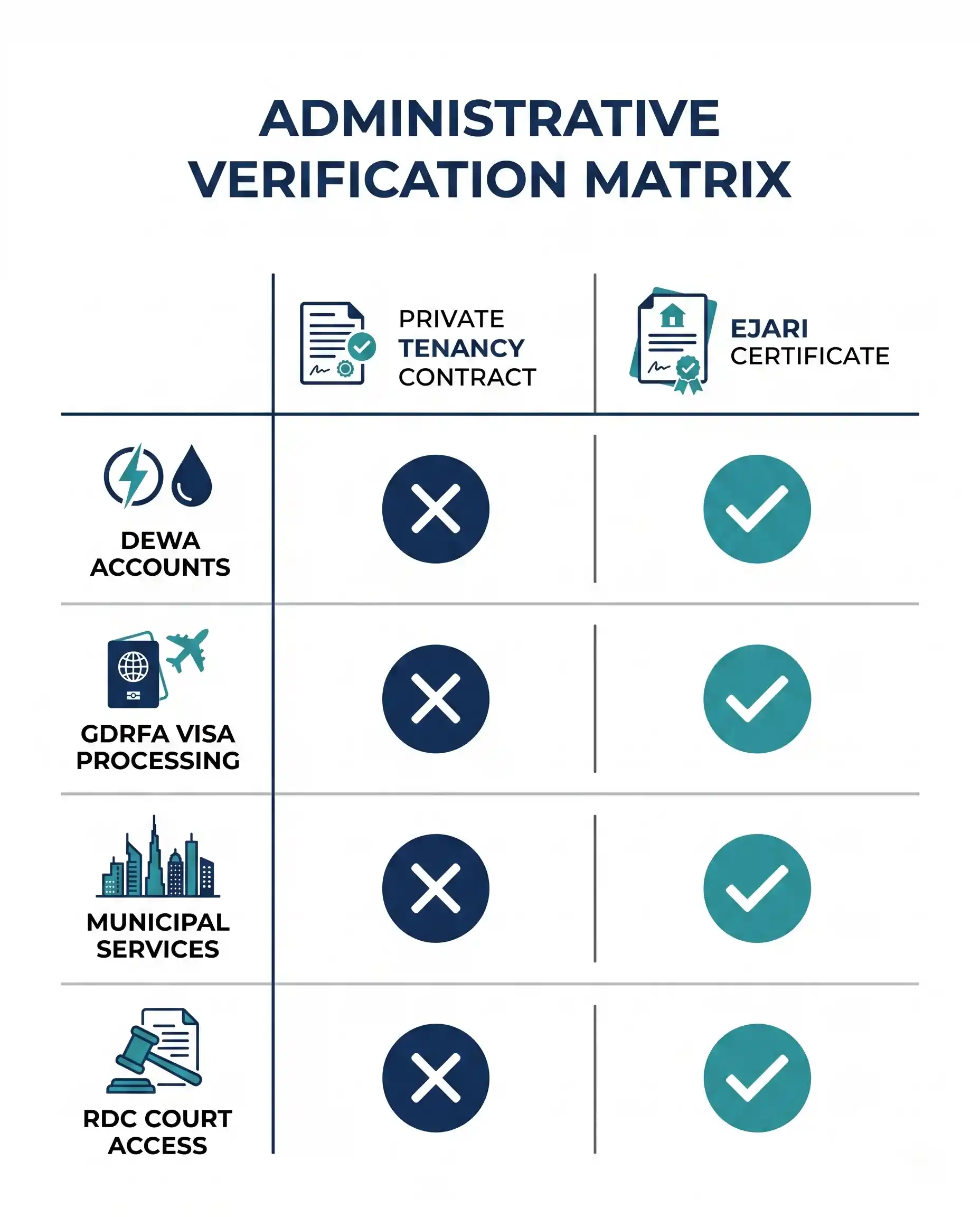
The comparison matrix shown above highlights why a private contract requires a government registration layer to become fully functional across municipal departments.
Feature Comparison Breakdown
| Operational Feature | Tenancy Contract | Ejari |
| Structural Nature | Private B2C / B2B document agreement | Centralized government registration entry |
| Primary Parties Involved | Tenant and Landlord only | Tenant, Landlord, and Dubai Authorities (DLD) |
| External Legal Recognition | Limited to basic contract law | Officially recognized across all UAE entities |
| Practical System Usage | Dictates individual room rules and terms | Serves as official proof for public services |
| Required for DEWA Connection | No (Rejected by utility portal) | Yes (Mandatory for meter linking) |
| Required for Residency Visas | No (Rejected by immigration) | Yes (Mandatory for family sponsorship) |
Why Both Ejari and Tenancy Contract are Needed
The modern real estate landscape operates on a layered compliance architecture. Analyzing the relationship of an Ejari vs tenancy contract shows that both documents serve completely different but deeply connected purposes within your housing pipeline.
The physical tenancy contract defines the custom rental terms, repair riders, and maintenance clauses unique to your arrangement. Conversely, Ejari makes those custom terms legally usable and recognizable in government systems. Without Ejari, tenants may face issues with utilities, visa processing, and address verification. Together, they create a complete legal rental framework in Dubai, protecting your financial deposits and civil stability.
Ejari vs Tenancy Contract in Daily Use
In day-to-day life, residents mainly refer back to their signed tenancy contract to check annual rent payment schedules, note building amenity rules, or communicate maintenance requests with the landlord. However, the moment you interact with any municipal or corporate institution, your standalone tenancy contract loses utility, and Ejari becomes necessary.
For example, connecting your home broadband lines, updating your Emirates ID address profile, activating water meters, and processing family visa renewals require a registered Ejari certificate, not just a tenancy contract. This is why a clear Ejari vs tenancy contract understanding is important for all tenants in Dubai to ensure their personal affairs continue to function smoothly.
Common Confusion About Ejari vs Tenancy Contract
Misinterpretations of real estate terms can cause unexpected issues for new market entrants. Many tenants believe that signing a physical tenancy contract is enough to secure their move-in and protect their rights. However, without proper Ejari registration, that private contract is not fully valid for official services or judicial support.
Another common point of confusion is thinking that an Ejari certificate completely replaces the need for a tenancy contract, which is incorrect. An Ejari vs tenancy contract evaluation shows that they work as two separate but connected systems, where one cannot exist without the other.
How to Register Ejari After Tenancy Contract
Once both parties place their matching wet or digital signatures on your lease pages, you must transition immediately to the verification phase. After signing a tenancy contract, the next step is formal Ejari registration.
The contract details are uploaded alongside the landlord’s title deed and both parties’ Emirates IDs into authorized digital channels to be recorded in the system. Once registered, tenants receive an Ejari certificate that can be used for official processes like DEWA activation and visa applications. Professional support platforms like Ejari Support can help simplify this step, checking your documents for errors to avoid rejections.
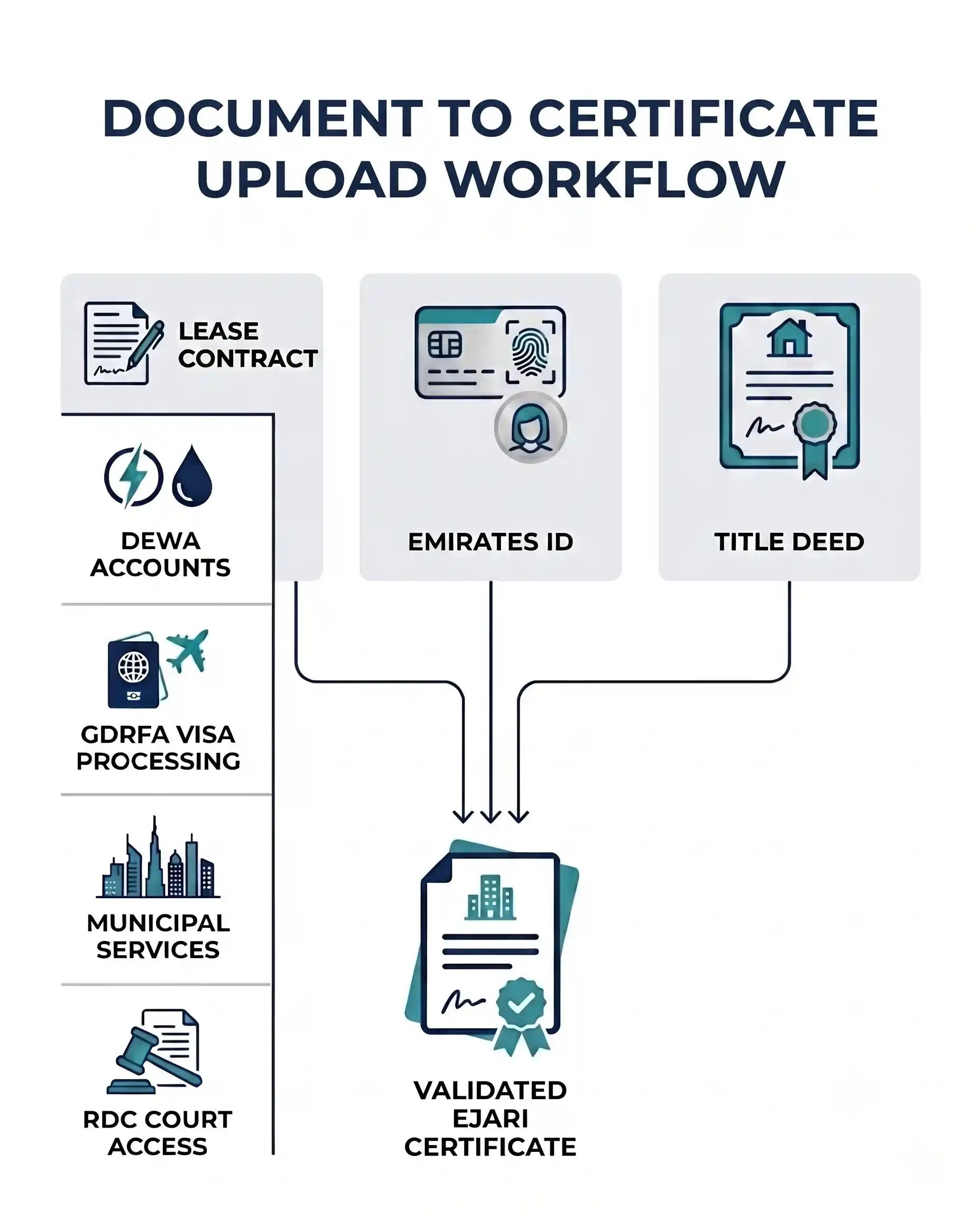
The technical data flow diagram shown above maps out the exact documentation conversion process required to turn a private lease into an official government certificate.
Once you understand the difference between an Ejari certificate and a tenancy contract, the next step is learning how the registration process actually works. Our guide, Ejari Registration Breakdown: Essential Steps, provides a complete overview of the Ejari registration process, including the required documents, application stages, and what tenants and landlords should expect from start to finish. Reviewing the full registration workflow can help you complete the process correctly and avoid unnecessary delays after signing your tenancy agreement.
Importance of Understanding Ejari vs Tenancy Contract
Protecting your investments requires knowing where your private agreements end and state enforcement begins. Understanding the clear differences in an Ejari vs tenancy contract helps tenants avoid serious legal and administrative issues.
It ensures that rental agreements are properly documented, unalterable, and usable for all required municipal services. It also helps tenants complete tenancy registration Dubai requirements without delays, avoiding disruptions to their daily routine. This structural knowledge is essential for both new expatriates and experienced corporate real estate managers in Dubai.
Conclusion
Navigating the local real estate sector is straightforward once you understand how separate municipal systems coordinate. An Ejari vs tenancy contract comparison is not about choosing one over the other but understanding how both work together to protect your tenancy.
The tenancy contract defines the private agreement, while Ejari makes it legally valid for government use. Knowing the difference helps tenants avoid administrative confusion and ensures smooth rental and residency processes in Dubai. For quick, error-free Ejari registration and support, you can visit Ejari Support for expert assistance.
FAQs
Is Ejari the same as a tenancy contract?
No, an Ejari vs tenancy contract review shows that Ejari is the official registration of the contract, not the physical contract itself.
Why is Ejari required in Dubai?
Ejari is required to link your lease data with government services like DEWA setup, visa processing, and corporate trade licensing.
Can I use a tenancy contract without Ejari?
Yes, but only as a private reference between you and your landlord, not for official government services.
Which comes first, Ejari or a tenancy contract?
The physical tenancy contract comes first, as it must be signed by both parties before you can initiate your Ejari registration.
Is Ejari mandatory for all rentals?
Yes, Ejari registration is required for legal recognition and protection under rental laws in Dubai.