
Ejari for Sponsored Tenants: Company Housing Guide

Dubai is home to thousands of professionals whose accommodation is provided by their employers. Whether it is a company-leased apartment, staff accommodation, or corporate housing arrangement, tenancy registration remains an important requirement. Understanding how Ejari for sponsored tenants works can help employees, employers, and property managers ensure compliance with Dubai’s tenancy regulations.
Unlike standard residential rentals where tenants lease properties directly from landlords, company-sponsored housing often involves additional parties, including employers, corporate leasing departments, and property management companies. This can create confusion regarding who is responsible for registering the tenancy agreement and obtaining the Ejari certificate.
This guide explains how Ejari registration works for sponsored tenants, what documents may be required, and how company accommodation arrangements are typically handled in Dubai.
What Are Sponsored Tenants?
Sponsored tenants are individuals whose accommodation is arranged, leased, or paid for by an employer rather than directly by the employee.
Common examples include:
- Company-provided apartments
- Employee accommodation buildings
- Staff housing facilities
- Executive housing packages
- Corporate relocation accommodation
- Employer-sponsored residential units
In these situations, the tenancy agreement may be signed by the employer while the employee occupies the property.
Why Is Ejari Important for Company Housing?
Many employers assume that corporate leasing arrangements eliminate the need for tenancy registration. However, company housing arrangements often still require proper tenancy documentation and registration.
The importance of Ejari includes:
- Maintaining official tenancy records
- Supporting utility activation
- Facilitating employee residency procedures
- Ensuring compliance with Dubai regulations
- Protecting the interests of landlords and tenants
- Creating legally recognized occupancy records
Proper registration helps ensure that accommodation arrangements are formally documented within Dubai’s rental system. As the system is administered by the Dubai Land Department (DLD), tenants and landlords can refer to the official authority for tenancy registration policies, property regulations, and rental market guidance.
How Does Ejari for Sponsored Tenants Work?
The process for Ejari for sponsored tenants is generally similar to standard tenancy registration, although the contractual relationship may differ.
In many company housing arrangements:
- The employer signs the tenancy agreement.
- The company becomes the registered tenant.
- Employees occupy the property under company authorization.
- Property ownership remains with the landlord.
- Ejari registration reflects the official lease arrangement.
The exact structure depends on the specific housing agreement between the company and property owner.
Tenancy Contract Registration in Dubai
For company-sponsored accommodation, understanding the tenancy registration process is important because the employer may appear as the tenant while the employee occupies the property. The registration process can involve different documents and responsibilities depending on whether the company or employee is named on the tenancy agreement. Our Tenancy Contract Registration in Dubai guide explains the registration process, required documents, responsibilities, renewal requirements, and other important considerations for properly registering a tenancy agreement in Dubai.
Who Is Responsible for Registration?
Responsibility for registration usually depends on who appears on the tenancy contract.
If the Company Is the Tenant
In many corporate leasing arrangements:
- The employer signs the lease.
- The company becomes the official tenant.
- Registration is generally handled through the company or its authorized representative.
If the Employee Is the Tenant
In some cases:
- The employee signs the tenancy agreement directly.
- The employer may simply provide a housing allowance.
- Registration responsibilities may follow standard residential procedures.
Understanding the tenancy structure is essential before beginning the registration process.
Ejari Corporate Housing Arrangements Explained
Ejari corporate housing refers to accommodation leased by a company for employee use.
These arrangements are common among:
- Multinational corporations
- Construction companies
- Healthcare organizations
- Hospitality businesses
- Government-linked entities
- Relocation service providers
Corporate housing can range from executive apartments to large-scale employee accommodation facilities.
Benefits of corporate housing include:
- Centralized accommodation management
- Simplified relocation processes
- Consistent housing standards
- Administrative efficiency
- Employee convenience
Despite these advantages, tenancy registration requirements generally remain important.
Documents Commonly Required for Company Housing Registration
The exact documentation requirements may vary depending on the tenancy arrangement.
Commonly requested documents include:
- Tenancy contract
- Trade license of the company
- Emirates ID of authorized signatory
- Passport copies
- Property ownership documents
- Company authorization letter
- Supporting tenancy records
Providing complete documentation helps avoid delays during registration.
Common Documentation Challenges
Corporate housing registrations sometimes face additional administrative requirements.
Common challenges include:
- Missing authorization documents
- Expired trade licenses
- Incorrect company information
- Incomplete tenancy records
- Signatory verification issues
- Missing supporting documentation
Careful document preparation can help reduce processing delays.
The following checklist highlights the documents commonly required when registering company-provided accommodation in Dubai.
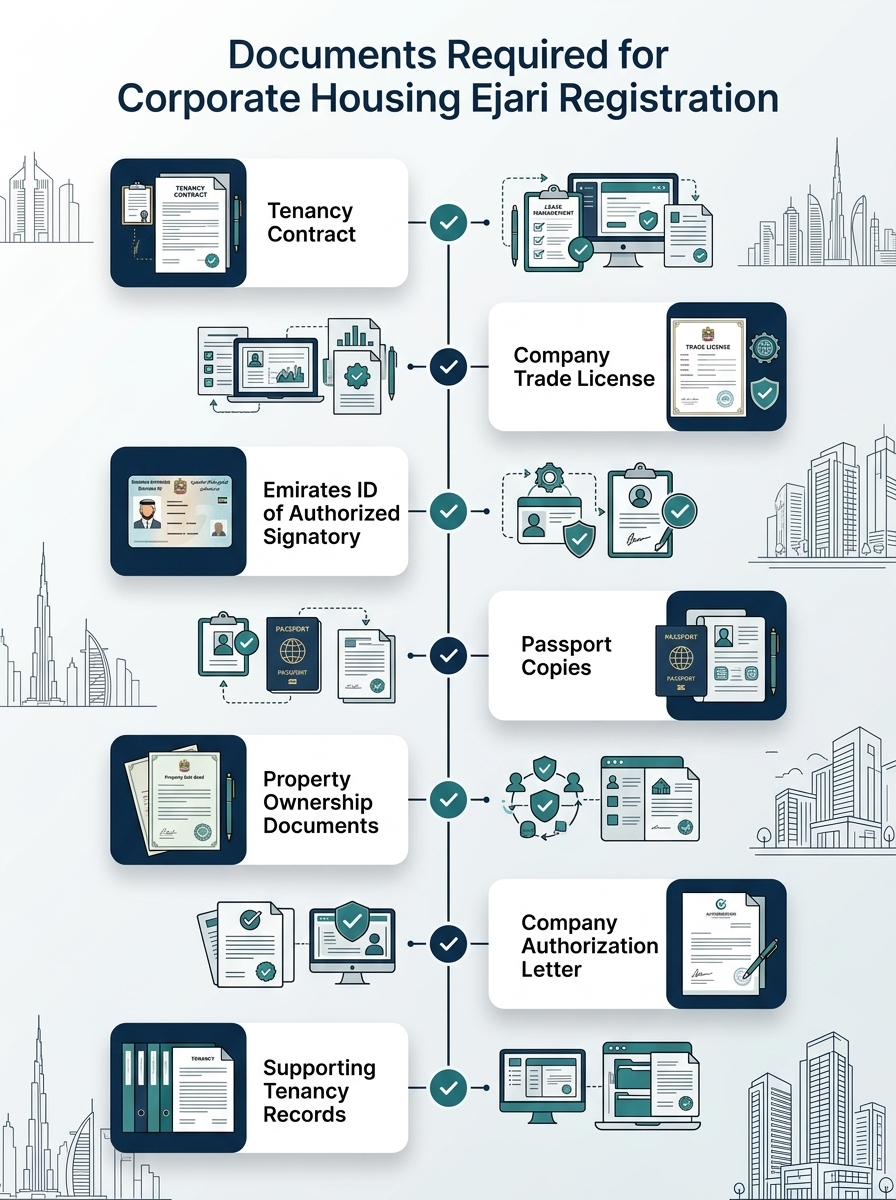
Preparing these documents in advance can help companies and employees complete the registration process more efficiently.
Ejari Employee Housing and Staff Accommodation
Ejari employee housing arrangements often involve accommodation leased specifically for workforce occupancy.
Examples include:
Staff Accommodation Buildings
Large residential facilities occupied by company employees.
Shared Employee Housing
Units designed to accommodate multiple employees under one corporate lease.
Executive Accommodation
Premium residential units provided as part of employment packages.
Temporary Relocation Housing
Short-term accommodation for newly relocated employees.
Each arrangement may involve different documentation and occupancy structures, but tenancy registration principles generally remain similar.
Ejari Company Accommodation and Utility Services
One of the key reasons for tenancy registration is its connection to utility and administrative services.
An Ejari company accommodation registration may support:
- Utility account activation
- Occupancy verification
- Government-related procedures
- Employee relocation processes
- Property administration requirements
Maintaining accurate tenancy records can help organizations manage accommodation more effectively.
In many accommodation arrangements, a valid Ejari registration may be required before utility accounts can be activated through DEWA, making tenancy registration an important part of the employee onboarding and relocation process
How Does Sponsorship Affect Tenancy Registration?
Many employees mistakenly believe that having a company sponsor automatically replaces tenancy registration requirements.
However, sponsorship and tenancy registration serve different purposes.
Employment Sponsorship
Employment sponsorship relates to:
- Work authorization
- Residency status
- Employment eligibility
Tenancy Registration
Tenancy registration relates to:
- Property occupancy
- Rental agreements
- Housing records
- Property compliance
Both systems may interact in certain situations, but they perform separate functions.
Ejari Visa Sponsor Considerations
The relationship between an Ejari visa sponsor and accommodation arrangements often raises questions among expatriate employees.
Key points include:
- Sponsorship status does not automatically create tenancy records.
- Housing arrangements should be properly documented.
- Company-provided accommodation may still require tenancy registration.
- Occupancy records should align with applicable regulations.
Employees should always confirm housing documentation requirements with their employer or accommodation administrator.
The following overview illustrates how employers, employees, landlords, and tenancy registration systems interact within a typical corporate housing arrangement.
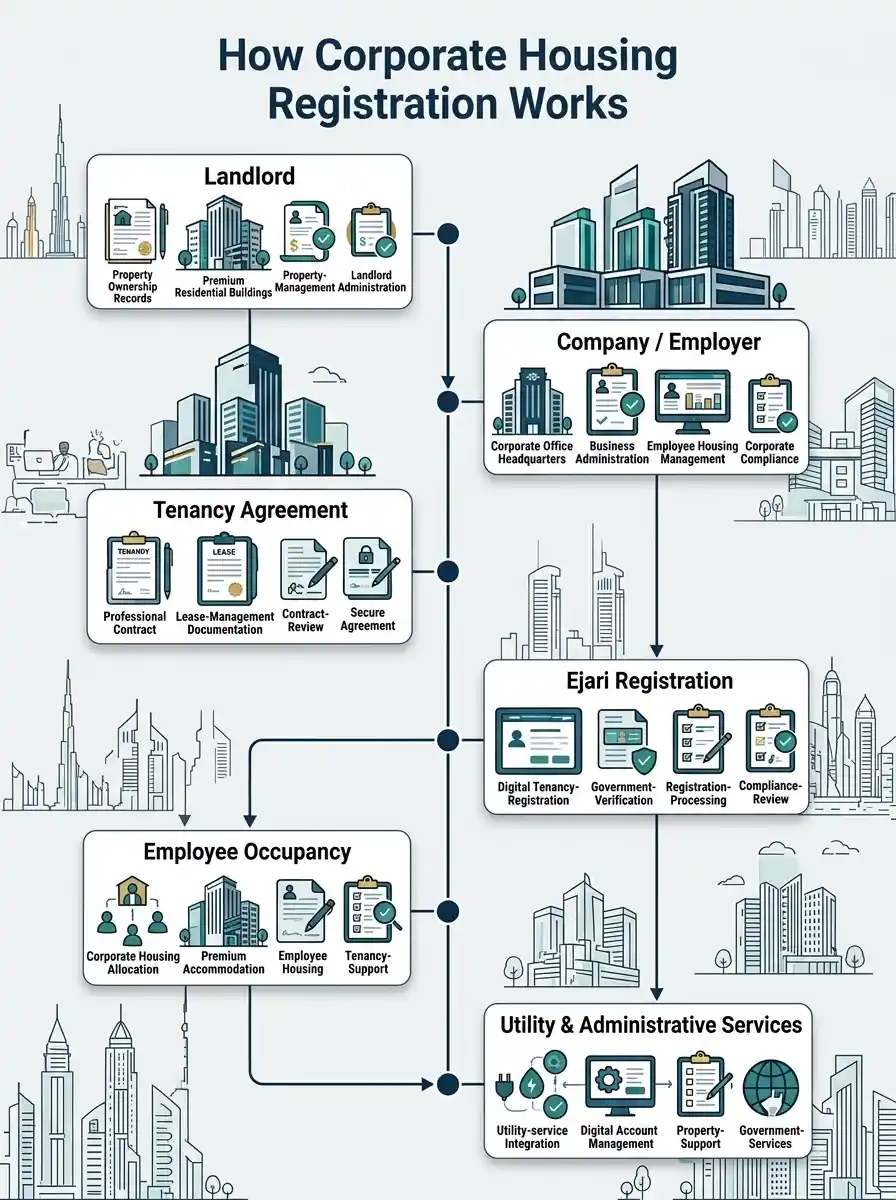
Understanding these relationships helps clarify registration responsibilities and ensure compliance with tenancy requirements.
Common Mistakes in Corporate Housing Registration
Organizations occasionally encounter registration issues due to:
- Missing trade license documentation
- Incorrect company details
- Unverified signatories
- Delayed registration submissions
- Incomplete authorization letters
- Mismatched tenancy records
Implementing a clear registration process can help reduce these risks.
Tips for Employers Managing Staff Accommodation
To improve efficiency and compliance:
- Maintain updated company records.
- Keep tenancy agreements organized.
- Verify signatory authorization.
- Monitor lease renewal dates.
- Retain copies of registration documents.
- Review accommodation records regularly.
These practices can simplify accommodation administration and reduce registration-related issues.
How Ejari Support Can Help
Corporate housing arrangements often involve additional documentation and administrative coordination.
Ejari Support assists with:
- Corporate housing registration guidance
- Ejari registration services
- Ejari renewals
- Document verification
- DEWA-related support
- Tenancy administration assistance
Our professional services can help organizations manage tenancy requirements efficiently while maintaining accurate records.
Conclusion
Understanding Ejari for sponsored tenants is essential for employers, employees, and property managers involved in company-provided accommodation. Whether managing Ejari corporate housing, staff accommodation, or executive residences, proper tenancy registration helps ensure compliance, transparency, and accurate occupancy records.
By maintaining complete documentation, understanding registration responsibilities, and properly managing Ejari employee housing arrangements, organizations can support smoother accommodation processes while meeting Dubai’s tenancy requirements. Regardless of the housing structure, accurate registration remains an important part of responsible property and workforce management.
FAQs
What are sponsored tenants in Dubai?
Sponsored tenants are individuals whose accommodation is leased, arranged, or paid for by their employer rather than rented directly from a landlord.
Does company housing require Ejari registration?
Many company accommodation arrangements still require tenancy registration to maintain official property records and support related services.
Who registers Ejari for corporate housing?
Registration is typically handled by the party named on the tenancy agreement, often the company or its authorized representative.
What documents are commonly required for corporate housing registration?
Requirements may include tenancy contracts, company trade licenses, identification documents, authorization letters, and supporting tenancy records.
Does an employment sponsor automatically handle Ejari registration?
Not necessarily. Sponsorship and tenancy registration are separate processes, and registration responsibilities depend on the tenancy arrangement.