
Dubai Short-Term Rental Market: 5 Smart Facts for 2026

2026 started as one of the strongest years on record for Dubai hospitality, then regional tension in late February changed the picture almost overnight. The Dubai short-term rental market absorbed a sharp shock, and owners who had grown used to steady tourist demand suddenly had to rethink their strategy. This blog looks at what actually happened, how the market is adjusting, and what it means for holiday home owners going forward.
Why Did Dubai Short-Term Rental Occupancy Drop in 2026?
The Dubai short-term rental market entered the year with strong momentum, supported by high hotel occupancy in January and February. That changed after a regional conflict broke out in late February, which triggered widespread booking cancellations and a sudden pullback in international leisure travel.
Key reasons behind the drop:
- International flight disruptions reduced the number of incoming tourists
- Thousands of short-term bookings across the UAE were cancelled within weeks
- Airport passenger traffic fell sharply during the first half of the year
- Traveler confidence dropped even after direct hostilities eased
By the second quarter, citywide occupancy for the Dubai short-term rental market had fallen well below its usual seasonal levels, marking one of the toughest stretches the sector has faced since the pandemic.
Are Long-Stay Bookings Replacing Tourism in Dubai?
To a large extent, yes. As leisure tourism slowed, long-stay rental demand for Dubai properties grew rapidly. Displaced regional residents, relocating expats, and professionals needing flexible housing filled much of the gap left by tourists.
What changed in guest behavior:
- Bookings of 29 or more nights increased sharply compared to the previous year
- Regional residents and expats began using short-term units as temporary housing
- Average length of stay for many operators moved well beyond the typical leisure booking
- Properties originally designed for short leisure stays were repositioned for month-long guests
This shift in long-stay rental demand Dubai has seen is not simply a seasonal blip. It reflects a structural change in who is booking these properties and why, and operators who adapted their pricing and marketing captured a meaningful share of this new demand.
Do Holiday Home Ejari Rules Change for Long-Term Guests?
This is a common point of confusion for owners pivoting toward longer stays in the Dubai short-term rental market. It is important to separate two different systems here. Short-term rentals in Dubai, including any arrangement involving guests staying under a DET Holiday Home permit, are not the same as a standard yearly lease registered through Ejari.
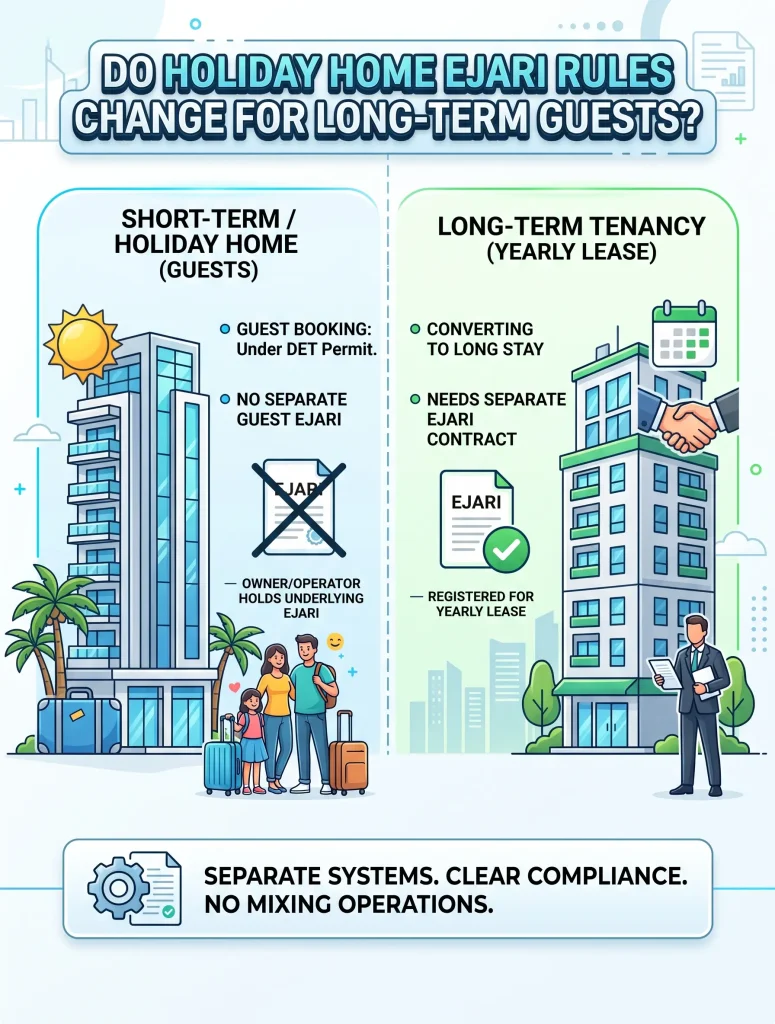
Here is how holiday home Ejari rules generally work:
- Guests booking a short-term stay through a licensed holiday home do not need to register their own Ejari contract
- The property owner or operator must still hold an active Ejari registration on the underlying lease or title
- If a guest wants to convert to a long-term yearly lease, that arrangement should be registered separately through Ejari
- Mixing short-term holiday home operations with informal long-term subletting without proper registration can create compliance issues
So while these obligations do not shift simply because a guest stays longer, owners offering month-long stays should be clear about which framework, holiday home licensing or standard tenancy registration, applies to each guest.
DET Permit Occupancy Rules Owners Should Understand
Every legally operating holiday home in Dubai needs a valid permit from the Department of Economy and Tourism, and this requirement did not change during the disruption. Understanding DET permit occupancy rules is essential for owners who want to stay compliant while adjusting their strategy.
Key points about permit requirements:
- Only properties with an active DET Holiday Home permit can legally be listed on booking platforms
- Individual owners are generally limited to a set number of units under one permit structure
- Permits must be renewed annually, and properties may be subject to periodic inspections
- Booking platforms have been removing unlicensed listings, which increases the value of proper compliance
Owners who kept their permit status active and up to date were in a better position to pivot toward long-stay guests without any legal gray areas, while unlicensed operators faced a much harder path during the downturn.
Is Short-Term Rental Still Profitable in Dubai?
Despite the disruption, the answer is largely yes, though margins have narrowed. Data from recent industry reports shows that professionally managed holiday homes continued to outperform traditional long-term rentals on a yield basis, even during the worst months of the downturn.
Reasons the Dubai short-term rental market remains viable:
- Well-managed short-term units still generated notably higher gross yields than long-term leases
- Flexible pricing allowed operators to capture new long-stay demand instead of losing revenue entirely
- Active listing counts remained well above pre-2025 levels, showing continued investor confidence
- Government incentives introduced during the recovery period helped support the wider tourism sector
The Dubai short-term rental market is clearly going through a period of adjustment rather than a permanent decline, and owners who stayed flexible with pricing and guest profiles were able to protect much of their income.
What This Means for Holiday Home Owners
For anyone currently operating in the Dubai short-term rental market, the past several months offer a clear lesson in flexibility. Relying entirely on leisure tourists is riskier than diversifying across guest types, and staying compliant with both DET and Ejari requirements protects owners regardless of which direction demand moves next.
Practical steps to consider:
- Review your DET permit occupancy status to confirm it is active and correctly renewed
- Reassess your pricing strategy to accommodate both short leisure stays and longer bookings
- Keep documentation for holiday home Ejari and DET compliance organized and easy to access
- Monitor long-stay rental demand and Dubai trends before committing to seasonal pricing months in advance
Conclusion
The Dubai short-term rental market has been tested this year, but the underlying fundamentals, strong tourism appeal, a large renter base, and continued investor interest, remain intact. Owners who adapted quickly to changing guest patterns and stayed compliant with permit and registration rules came through the disruption in a stronger position than those who did not.
If you need help sorting out your Ejari registration, understanding how it interacts with your DET permit, or simply want clarity on your compliance status, the team at Ejari is ready to help. Reach out to the team at Ejari today and keep your property fully compliant no matter which way the market moves next.
Frequently Asked Questions
Can a holiday home be converted into a long-term rental without extra approval?
Not automatically. Converting a short-term unit into a standard yearly lease usually requires a proper tenancy contract and Ejari registration separate from the DET permit.
What happens if a holiday home operates without a valid DET permit?
Operating without a valid permit can lead to fines, removal from booking platforms, and potential legal action from the authorities.
Do long-stay guests count toward standard tenancy rights in Dubai?
Generally, no, since guests staying under a DET Holiday Home permit are treated differently from tenants under a registered yearly lease.
How often does a DET Holiday Home permit need to be renewed?
DET permits typically require annual renewal, along with continued compliance with safety and quality standards.
Are individual owners limited in how many holiday home units they can operate?
Yes, individual operators are usually capped at a set number of units, while larger portfolios often require a professional operator license instead.