
Ejari Exemption Dubai: 5 Clear Rules You Can Trust

Most rentals in Dubai must be registered on Ejari, but not every property or living setup falls under that rule. Understanding Ejari exemption Dubai rules helps you avoid wasted fees, rejected applications, and legal surprises. This guide explains which properties and arrangements sit outside the system, and what you should do in each case.
What Ejari Normally Covers
Ejari is the Dubai Land Department (DLD) system that registers tenancy contracts. It applies to full residential units such as apartments and villas, and to commercial units such as shops, offices, and warehouses. The landlord is legally responsible for making sure the contract is registered, although tenants often complete the process themselves because they need the certificate for visas, utilities, and licensing.
So the real question is not whether Ejari is important. It is which properties and arrangements fall outside it.
Which Properties and Living Arrangements Are Exempt From Ejari?
The short answer is that Ejari exemption Dubai rules depend on the type of property and on who regulates it. These are the main cases:
- Holiday homes licensed by Dubai tourism authorities, because short guest stays sit outside the tenancy law
- Hotel apartment units that operate with hotel services
- Properties inside DIFC, which follow their own leasing regime
- Properties outside Dubai, since Ejari is a Dubai-only system
- Partitioned rooms, bed spaces, and shared units, which usually do not receive Ejari unless the landlord has official approval
You will often hear these grouped as non-Ejari properties Dubai owners and tenants ask about. Each one has its own alternative route, explained below.
Do DIFC and ADGM Free Zone Properties Require Ejari Registration?
DIFC is located in Dubai, but it has its own legal system and its own leasing framework. Leases there follow DIFC lease registration rules handled by DIFC authorities, not by the standard Ejari process. Confirm the exact steps with DIFC before you sign anything.
ADGM is different. It is a free zone in Abu Dhabi, so Ejari does not apply to it at all. Abu Dhabi runs its own tenancy registration system.
For other Dubai free zones, requirements can vary. Some use their own lease registration, while others accept Ejari for specific purposes. Always check with the free zone authority. In short, Ejari exemption Dubai rules for free zones depend on the zone, so never assume. Keep DIFC lease registration rules in mind if your office or home sits inside that district.
Are Hotel Apartments and Serviced Residences Exempt From Ejari?
Not fully. Units that run with hotel services, such as cleaning, linen, and a reception-style operation, are usually blocked from Ejari. In these cases, hotel apartment rental registration follows hotel and tourism rules instead of the normal tenancy route.
There is an important exception. If a hotel apartment unit does not run with hotel services, the owner can ask the DLD for approval to allow Ejari. Once the DLD confirms the unit status with the Department of Economy and Tourism, registration may become possible.
Serviced residences vary from building to building. Before you buy or rent, ask these questions:
- Does the unit include hotel services?
- Is Ejari allowed in this building?
- Has the owner already received DLD approval?
Check the hotel apartment rental registration route before you list or lease the unit. This is one of the clearest Ejari exemption Dubai cases that can be changed with the right approval.
Does Company-Provided Staff Accommodation Need Individual Ejari Certificates?
In general, no. Ejari registers a tenancy contract, not every person living in the property. When a company rents units for its staff, the company signs the contract and registers it once for each unit. Staff members do not need separate certificates. This keeps Ejari exemption Dubai questions simple for employers.
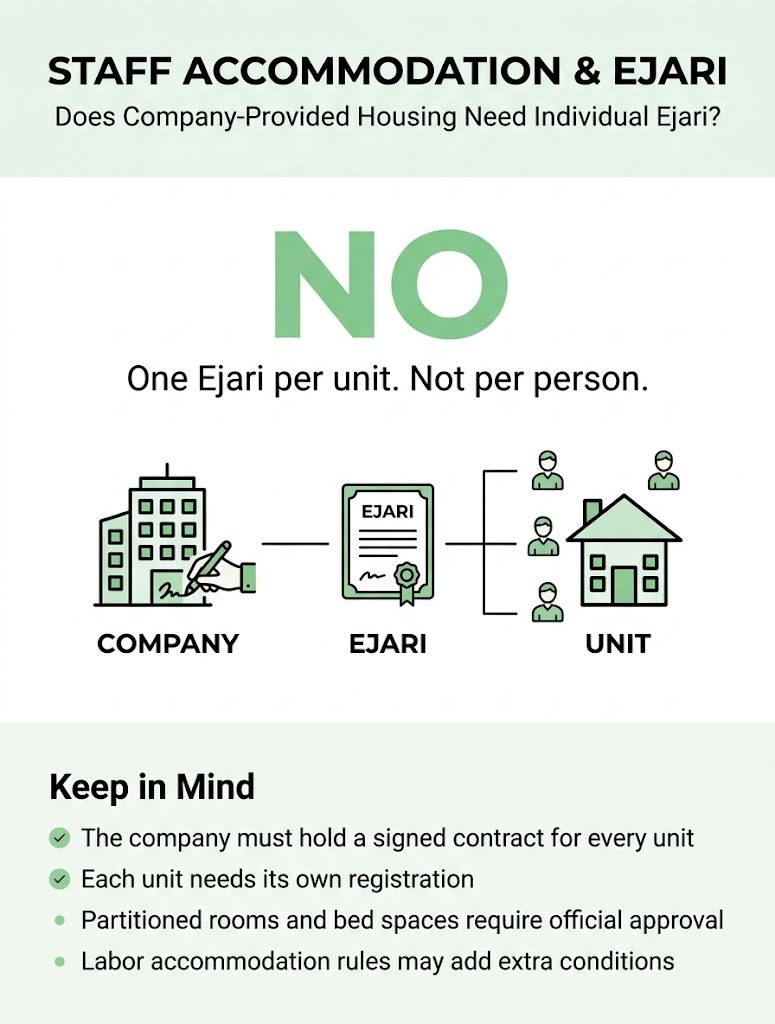
Still, keep these points in mind:
- The company should hold a signed tenancy contract for every unit
- Each unit needs its own registration where Ejari applies
- Partitioned rooms and bed spaces usually need official approval
- Labor accommodation rules may add extra conditions
Are Long Stay Airbnb Guests Required to Register Ejari?
Generally, no. Short-term stays in licensed holiday homes sit outside the tenancy law. The agreement between host and guest cannot be registered on Ejari, so the guest does not receive tenancy rights such as lease renewal or a visa linked to the contract.
This is where problems start. If a stay becomes a normal long-term rental, the host and guest should sign a proper lease and register it. Relying on a Dubai tenancy contract without Ejari leaves the guest with little protection and the host with possible compliance issues. Ejari exemption Dubai rules protect the holiday home model, not informal long-term leases.
What Goes Wrong Without Registration
Even where an exemption applies, you still need a clear written agreement. For a standard long-term rental, a Dubai tenancy contract without Ejari can cause:
- Trouble connecting utilities such as water and electricity
- Problems with residency and family visa applications
- A weak legal position in a rental dispute
- Difficulty proving your address for licensing or banking
Many people believe that Ejari exemption Dubai rules apply to any informal arrangement. They do not. The exemptions are specific, and they depend on the property type and the regulator.
A Simple Checklist Before You Rent or List
Use this quick list to avoid mistakes:
- Confirm the property type, such as apartment, hotel apartment, or holiday home
- Identify who regulates it, such as the DLD, DET, or DIFC
- Ask the landlord or operator for written confirmation of the registration route
- Review DIFC lease registration rules if the property is in that district
- Contact the DLD when the property appears to be among the non-Ejari properties Dubai buyers often confuse with normal units
- Keep a signed agreement and proof of payment in every case
Following this checklist makes every Ejari exemption Dubai decision safer and faster.
Conclusion
Ejari exemption Dubai rules are narrow and depend on the property, the operator, and the regulator. Holiday homes, DIFC premises, and units that run with hotel services follow different routes, and hotel apartment rental registration may still lead to Ejari after DLD approval. Avoid signing a Dubai tenancy contract without Ejari unless you are sure the property truly sits among the non-Ejari properties Dubai law recognizes.
Not sure whether your property needs Ejari? Contact the Ejari team today and get clear, quick guidance before you sign.
Frequently Asked Questions
Does Ejari apply to a property I own and live in?
No. Ejari registers tenancy contracts, so an owner living in their own unit does not need it.
Who must register Ejari, the landlord or the tenant?
The landlord carries the legal responsibility. In practice, many tenants complete the registration themselves because they need the certificate.
Can I register Ejari for a partitioned room or bed space?
It is usually not issued for partitioned rooms, bed spaces, or shared units unless the landlord has official approval and the contract is registered under one tenant.
Do other Dubai free zones outside DIFC require Ejari?
It depends on the zone. Some run their own lease systems, so check with the free zone authority before you register.
Where can I register Ejari for a property that qualifies?
You can register through approved service channels or the official DLD app, using your tenancy contract and the required documents.