
Villa vs Apartment Ejari Dubai: 5 Key Facts for 2026

Choosing between a villa and an apartment in Dubai is not just about lifestyle preference anymore. In 2026, it is also a question of what is actually available, how much it costs, and whether the registration process differs once you sign a lease. Understanding villa vs apartment Ejari rules helps renters plan more realistically before they start their property search.
This guide breaks down the current supply picture, pricing gap, and registration process for both property types, so you know exactly what to expect this year.
Are Villas Harder to Rent in Dubai Than Apartments?
Yes, in most established communities, villas are noticeably harder to find than apartments. This is one of the clearest patterns shaping villa vs apartment Ejari discussions this year, since scarcity on one side of the market changes how renters approach both options.
A few reasons villas are harder to secure:
- Villa communities occupy fixed land parcels, unlike apartment towers that can add units more quickly
- Family tenants tend to stay in villas longer, which reduces how often units become available
- New villa supply scheduled for delivery remains limited compared to overall housing demand
- Popular villa communities with strong schools and infrastructure see the highest competition among renters
Because of this imbalance, villa vs apartment Ejari conversations increasingly focus on availability first and paperwork second, since finding the right villa can take considerably longer than finding a comparable apartment.
Why Is Villa Supply Limited in Dubai?
Villa rental scarcity in Dubai has become a defining feature of the 2026 market. Unlike apartments, which can be delivered through high-density towers, villas require larger land plots and longer development timelines, which naturally caps how quickly new supply can be added.
Key factors driving villa rental scarcity Dubai-wide:
- Limited land availability in mature, low-density communities
- Long construction and infrastructure timelines for new villa developments
- Strong demand from relocating families who prioritize space and privacy
- A structural shortage where new villa deliveries fall short of actual demand
This scarcity has pushed villa rents higher relative to apartments, with the gap between the two property types continuing to widen through 2026 even as overall rental growth in the city has slowed. This growing gap is now one of the more important factors shaping villa vs apartment Ejari decisions for families weighing their next move.
Apartment Rental Trends Shaping the Market
While villas remain scarce, apartment rental trends in 2026 tell a different story. Apartment supply has grown steadily, giving tenants more choice and, in several communities, more negotiating power than in previous years.
What current apartment rental trends show:
- Apartment rents have grown at a more moderate pace compared to the sharp increases seen in prior years
- Several apartment-heavy districts are expected to see flatter rental growth through the second half of the year
- Apartments still account for the large majority of all rental demand across the city
- Newer communities are helping absorb population growth without the same land constraints villas face
These trends suggest a market that is maturing rather than cooling entirely, with landlords and tenants both adjusting to a more balanced pace of growth.
Do Villas and Apartments Have Different Ejari Requirements?
This is one of the most practical questions in any villa vs apartment Ejari comparison, and the good news is that the core registration process is largely the same for both. Ejari is a government system that applies to residential tenancy contracts regardless of property type.
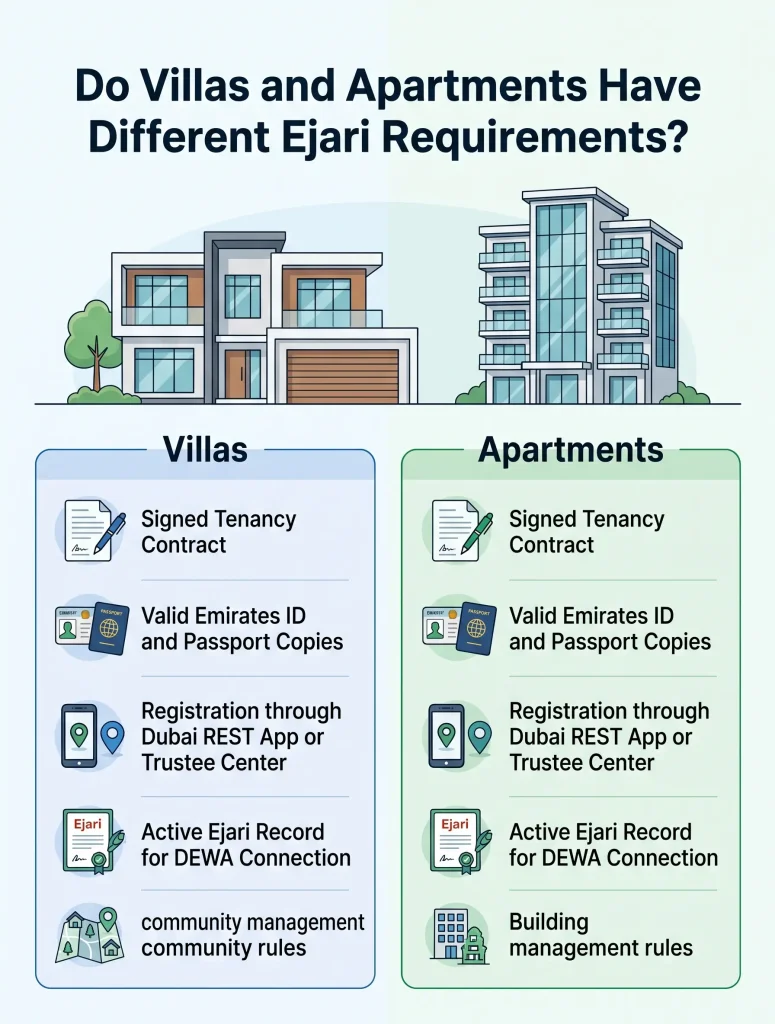
What stays consistent across villa vs apartment Ejari registration:
- Both require a signed tenancy contract between landlord and tenant
- Both need valid Emirates ID and passport copies for registration
- Both are typically registered through the Dubai REST app or an approved trustee center
- Both require an active Ejari record before DEWA services can be connected
The main differences tend to be practical rather than procedural. Villa contracts sometimes include community or homeowners association details, while apartment contracts may reference building management rules, but the fundamental Ejari steps remain the same either way.
What Percentage of Dubai Renters Choose Apartments?
Apartments continue to dominate the rental market by a wide margin. Recent data shows apartments account for roughly seven in ten rental transactions across the city, while villas make up a smaller but growing share of overall demand.
A closer look at rental preferences:
- One-bedroom rental demand remains the single largest category, representing more than four in ten tenancy contracts registered so far this year
- Two-bedroom units follow as the next most common choice among renters
- Villas and townhouses, while a minority of transactions, have grown their share of demand year on year
- Affordability continues to push many renters toward smaller apartment units even as household sizes grow
The strength of one-bedroom rental demand in particular reflects how many renters in Dubai are singles, couples, or young professionals prioritizing cost and flexibility over space.
What This Means for Renters in 2026
If you are weighing villa vs apartment Ejari considerations this year, the decision often comes down to timing, budget, and how much flexibility you have in your search. Villa rental scarcity Dubai-wide means villas offer more space but require patience and a larger budget, while apartments offer faster availability and a wider range of price points.
Practical tips before you start your search:
- Budget for a higher price gap between villas and apartments than in previous years
- Expect a longer search timeline if you specifically want a villa in an established community
- Compare one-bedroom rental demand trends in your target area before committing to a unit size
- Confirm Ejari registration steps with your landlord or agent regardless of which property type you choose
Conclusion
Whether you end up in a villa or an apartment, understanding villa vs apartment Ejari rules from the start makes the moving process far less stressful. Villas remain harder to find and more expensive relative to apartments, while apartments continue to offer more choice and steadier pricing, but the registration process itself does not change based on which one you pick.
If you need help registering your tenancy contract, whether it is for a villa or an apartment, the team at Ejari is ready to assist. Reach out to the team at Ejari today and get your lease registered correctly from day one.
Frequently Asked Questions
Does a villa lease typically cost more to register than an apartment lease?
No, the government registration fee structure is generally the same regardless of property type, though total costs can vary slightly by trustee center.
Are villa tenants required to register additional documents beyond a standard Ejari contract?
Not usually, though some villa communities may ask for extra homeowners association paperwork alongside the standard registration documents.
Can a tenant switch from an apartment to a villa mid-lease term?
Yes, but this requires ending the current tenancy properly and registering a new Ejari contract for the villa once a lease is signed.
Why do some renters choose apartments even when they can afford a villa?
Many renters prioritize convenience, shorter commutes, and building amenities, which apartments in central areas often provide more readily than villas.
Is it faster to get DEWA connected for an apartment compared to a villa?
Not typically, since DEWA activation depends on having an active Ejari registration rather than the type of property being rented.
When renting a property in Dubai, one of the key steps in setting up utilities is paying a DEWA (Dubai Electricity and Water Authority) security deposit. This deposit ensures seamless activation of electricity and water services and serves as a financial guarantee against unpaid bills. Here’s everything tenants need to know about DEWA security deposits, including costs, refund processes, and common queries.
What is a DEWA Security Deposit?
A DEWA security deposit is a refundable amount that tenants must pay when registering for water and electricity services in Dubai. This deposit acts as financial security to cover any outstanding bills or damages before the tenant vacates the property. The deposit remains with DEWA until the tenant formally closes their account and applies for a refund.
How Much is the DEWA Security Deposit?
The amount of the DEWA security deposit varies based on the type of property:
- Apartments: AED 2,000
- Villas: AED 4,000
In addition to the security deposit, DEWA also requires a connection fee, which varies depending on the size of the property and the required services. The connection fee is a non-refundable charge.
How to Pay the DEWA Security Deposit?
You can pay your DEWA security deposit through multiple convenient methods:
✔ Online via DEWA website or DEWA smart app
✔ At DEWA customer service centers
✔ Through bank payment channels (online or ATM)
✔ Via Apple Pay or Samsung Pay
✔ Using credit/debit cards
✔ Through payment kiosks available across Dubai
When Should You Pay the DEWA Security Deposit?
The DEWA security deposit must be paid before activating your electricity and water services. Typically, it should be settled immediately after signing the tenancy contract and before moving into the new property.
How to Get a Refund on Your DEWA Security Deposit?
When vacating the property, tenants can request a refund of their security deposit. Follow these steps for a smooth refund process:
Step 1: Apply for Final Bill Request
Before moving out, submit a final bill request on the DEWA website or mobile app. DEWA will generate a final invoice, including any pending charges.
Step 2: Settle Outstanding Bills
Ensure that all outstanding bills are paid to avoid delays in the refund process.
Step 3: Submit Refund Request
Once your final bill is cleared, request a refund through DEWA’s official website or customer service center. You’ll need to provide:
- Emirates ID copy
- Proof of final bill payment
- IBAN details for bank transfer (if applicable)
Step 4: Receive Your Refund
Refunds are processed via:
- Bank transfer (IBAN required)
- Cheque collection at DEWA offices
- Refund via DEWA-approved payment channels
The refund process typically takes 7-10 working days.
Common Issues and How to Avoid Them
🚫 Delayed Refunds: Ensure all outstanding dues are cleared before applying.
🚫 Incorrect Bank Details: Double-check IBAN details to prevent refund rejections.
🚫 Missed Final Bill Request: Always apply for a final bill at least a week before vacating.
🚫 Wrong Contact Information: Ensure your contact details are updated to receive refund updates.
What Happens If You Don’t Claim Your Refund?
If a tenant does not claim their DEWA security deposit refund, the amount remains with DEWA. It is advisable to initiate the refund process as soon as possible after vacating the property to avoid complications.
FAQs About DEWA Security Deposits
1. Is the DEWA deposit refundable?
Yes, the deposit is fully refundable once all bills are settled and the final bill request is completed.
2. Can I transfer my DEWA deposit to a new property?
No, you must request a refund for the existing deposit and pay a new security deposit for the new property.
3. How long does the DEWA refund process take?
Refunds typically take 7-10 working days after the final bill is cleared.
4. Can I pay the DEWA security deposit in installments?
No, the security deposit must be paid in full before the electricity and water connection is activated.
5. What happens if I don’t pay my DEWA deposit?
Your utility services will not be activated until the security deposit is successfully paid.
6. Can landlords pay the DEWA deposit instead of tenants?
While some landlords may offer to cover DEWA deposits as part of rental agreements, the responsibility typically lies with the tenant.
7. Does DEWA charge additional fees apart from the deposit?
Yes, apart from the deposit, DEWA charges monthly consumption fees and connection fees, which are non-refundable.
Need Assistance with DEWA Setup?
Let us help you with hassle-free DEWA registration, deposit payments, and refunds. Get expert assistance today!
📞 Call us now or visit: Ejari Services